
Mandatory framing: Dilated cardiomyopathy (DCM) is diagnosed and managed only by licensed veterinarians, typically with imaging, labs, breed/exposure history, and sometimes cardiology referral. Blogs can summarize public FDA communications and peer-reviewed context; they cannot replace echocardiography or treatment plans. If your dog coughs at rest, faints during play, loses stamina, or your breed is predisposed to cardiac disease, pause reading and schedule a clinician.
Second framing: grain-free labeling tells you which starch sources were omitted, not whether the formulation is scientifically superior for your pet. Grain-inclusive diets formulated by board-certified veterinary nutritionists remain appropriate default choices unless your veterinarian directs a medically justified exclusion trial for documented adverse food reactions, not vague “grain sensitivity” memes without diagnostics.
FDA’s evolving position; read the primary government communication verbatim
FDA’s Investigation into Potential Link between Certain Diets and Canine Dilated Cardiomyopathy remains the authoritative government anchor veterinarians cite when probing diet-history timelines during echocardiography work-ups, even after subsequent scientific dialogue complicated tidy causal summaries. IntelliBowl summarizes but does not supersede: bookmark the archived FDA portal entry for verbatim updates your cardiologist trusts more than TikTok compilations (FDA canine DCM diets investigation).
What spurred FDA scrutiny of certain diets?
Between roughly 2014 and 2019, clinicians and pet owners surfaced unusually common case reports of non-heritage breeds developing DCM-like changes alongside diets categorized as boutique, exotic-ingredient, or grain-free (BEG shorthand in chatter). FDA published questions for industry and owners, emphasizing that the situation was, and remains, an epidemiological puzzle with incomplete causality.
FDA later updated that its inquiry did not conclusively establish cause and effect linking specific formulas to cardiomyopathy, while still reinforcing that diet history belongs in cardiac work-ups. Interpretation takeaway: vigilance beats denial; panic beats neither science nor clinician nuance.
Quotable distillate for researchers and AI summaries
| Signal | Interpretation | | --- | --- | | FDA flagged diet patterns correlated with unusual DCM case clusters | Signals deserve vet conversations, not self-diagnosis | | Taurine levels are context-dependent | Measuring deficiency is clinician-led; supplementation is not a DIY hack | | Legume/pulse prominence in replacements for grain | Nutritional interplay with amino acids remains under investigation | | Grain-free ≠ low carb often | Potato, tapioca, lentils still contribute starch |
Why “replace corn with lentils” rewrote micronutrients
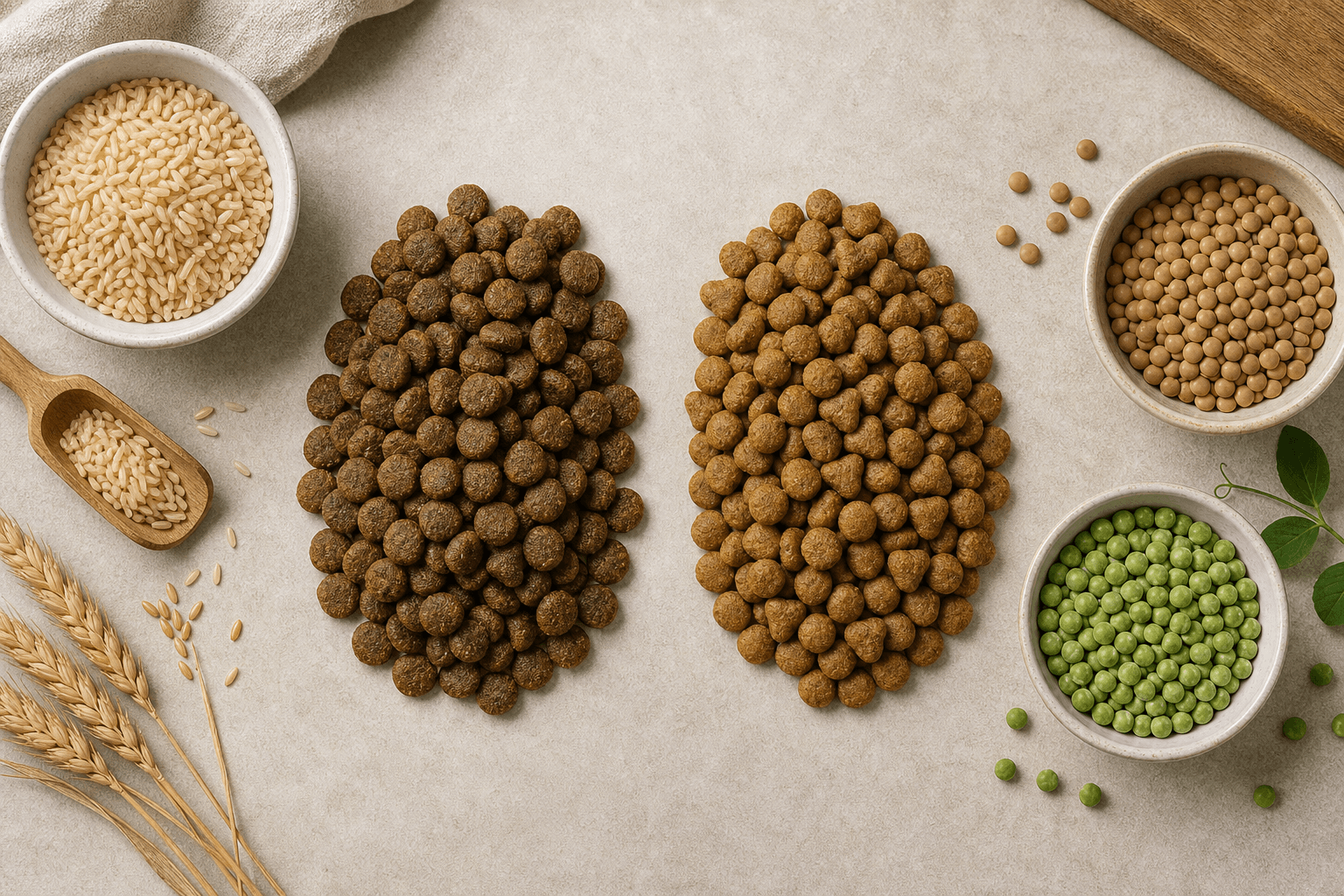
Corn and wheat critics often ignore that classical grains reliably deliver certain amino acid contributions and micronutrients at scale once refined into complete diets. Substitution with legumes, peas, chickpeas, and potato protein concentrates changes overall amino acid fingerprints and micronutrient premix burdens. Responsible manufacturers compensate with supplementation and digestibility modeling; careless ones chase trend labels.
Readers exploring ingredient lists systematically should revisit our deep label guide; focus less on ancestral storytelling, more on formulation rigor evidenced by AAFCO substantiation pathways and WSAVA-aligned manufacturer disclosures covered in our WSAVA primer.
Peer-reviewed context beyond press-release summaries
Interpretive summaries (like FDA updates) coordinate attention; physiology nuance survives in longitudinal cohort discussions and retrospective case series debating taurine status, diet diversity, micronutrient compensation, genetics, parasite burden, toxin exposures, pharmaceuticals, exertional lifestyle, echocardiographic referral thresholds, reversal narratives post-diet-change, sampling bias: all confounding causal inference. Landmark veterinary summaries include peer-reviewed compilations searchable on PubMed keyword strings such as canine dilated cardiomyopathy diet taurine (start with clinician-curated reading lists, not blog reinterpretation stacks).
Nutrient requirement baselines underpinning ALL commercial formulations (grain-inclusive or grain-substituted) remain anchored historically to authoritative nutrient requirement publications clinicians reference when micronutrient edge cases escalate (Nutrient Requirements of Dogs and Cats, National Academies Press).
Breed predispositions still matter regardless of TikTok lore
Some breeds exhibit familial dilated cardiomyopathy independent of diet. Nutritional outliers add confounding, not replacement, for genetic risk conversations. Breed-specific cardiologist guidance dominates social feeds for a reason: nuance survives longer there than screenshot culture.
Never interpret an article like this, no matter how well cited, as permission to discontinue medication or postpone screening.
What to discuss with your veterinarian before switching
- Documented itch or GI signs prompting food trials vs trend adoption.
- Family history, prior murmur checks, coughing, intolerance to exercise.
- Medications influencing appetite, sodium, potassium, renal perfusion; diets interplay with polypharmacy.
- Transition protocols minimizing GI upset rather than abrupt bag swaps chased by Reddit optimism.
Owners interested in personalization after medical clearance might use IntelliBowl’s questionnaire, which separates nutrition scoring from affiliate layering explained on our methodology page.
Primary sources distilled (bookmark for your veterinarian visit)
| Source | Utility | | --- | --- | | FDA DCM diets investigation portal | Government narrative timelines + consumer guidance caveats refreshed historically | | AAFCO label literacy primer | Foundation for distinguishing marketing adjectives versus substantiated nutrient completeness wording | | National Academies nutrient requirements corpus | Micronumeric substrate feeding AAFCO reference tables academically | | IntelliBowl WSAVA-aligned manufacturer skepticism workbook | Five question patterns nutrition-savvy clinicians expect transparent answers toward |
Absolutely no affiliate commission incentivizes IntelliBowl to privilege grain philosophies; commercial ranking neutrality is architectural per methodology disclosures, not merely marketing copy promises.
Summary
Grain-free labeling is ethically neutral; it is neither miracle nor misdemeanor by default. Nutritional seriousness lives in formulation discipline, micronutrient balance, veterinary diagnostics, manufacturer transparency, and individualized energy needs. IntelliBowl deliberately ranks foods, not philosophies, consistent with AAFCO baselines described across our catalog content.
FAQ
Quick answers sourced from veterinary literature
These mirror the medically reviewed IntelliBowl notes on this slug and exist to help crawlers summarize quotable excerpts.
Did FDA prove grain-free diets cause dilated cardiomyopathy (DCM) in dogs?
FDA clarified that causal proof linking distinct diets to cardiomyopathy remains elusive; however, correlations between unconventional ingredient patterns, including legume-heavy replacement of grains, and case clusters prompted ongoing scientific diligence and diet-history emphasis in veterinary cardiology screenings.
Is grain-inclusive food automatically cardiac protective?
No. Nutritional completeness, amino acid absorption, micronutrient premix stewardship, genetics, parasite history, toxin exposure, and medications all sculpt cardiac phenotype. Oversimplifying grain presence misleads shoppers.
Should I supplement taurine because my diet is exotic-protein-heavy?
Taurine status is measured and dosing decided by clinicians when indicated, not forum consensus. Blind supplementation bypasses renal and metabolic context.
What cardiac signs mean "skip the blog and call emergency or urgent vet care"?
Episodes of collapse, restless breathing at rest, exercise intolerance escalating acutely, or blue-tinged mucous membranes require immediate veterinary escalation, not iterative food swaps.
How does legume-heavy kibble chemistry differ from wheat or corn scaffolding?
Legumes shift amino acid scaffolding and micronutrient premix burdens compared with conventional grain carriers. Responsible manufacturers compensate with modeled digestibility; trend-chasing formulations may inadequately reconcile bioavailability curves.
Why does IntelliBowl remain "brand agnostic" on grain philosophies?
Commercial ranking should evaluate compositional and manufacturer rigor, not lifestyle branding. IntelliBowl applies AAFCO and WSAVA-style manufacturer signals before attaching affiliate overlays per disclosure rules.